Showing posts with label GCC. Show all posts

27 January, 2011

Applying theories

Generative art and generative literature are best perceived through practice (e.g. theory is not as captivating as the examples found online). One does not have to be an artist to create fascinating masterpieces. Only a clear understanding of rules and how to design them, is required. Imagination is paramount.

The first thing that comes to mind while discussing generative art, is John Conways "Game of Life." In fact, it's not really a game. There are no winners or losers. The concept of the player is lost as well. There is a designer, though.

The rules are very simple:

The universe of the Game of Life is an infinite two-dimensional orthogonal grid of square cells, each of which is in one of two possible states, live or dead. Every cell interacts with its eight neighbours, which are the cells that are horizontally, vertically, or diagonally adjacent. At each step in time, the following transitions occur:

1. Any live cell with fewer than two live neighbours dies, as if caused by under-population.
2. Any live cell with two or three live neighbours lives on to the next generation.
3. Any live cell with more than three live neighbours dies, as if by overcrowding.
4. Any dead cell with exactly three live neighbours becomes a live cell, as if by reproduction.
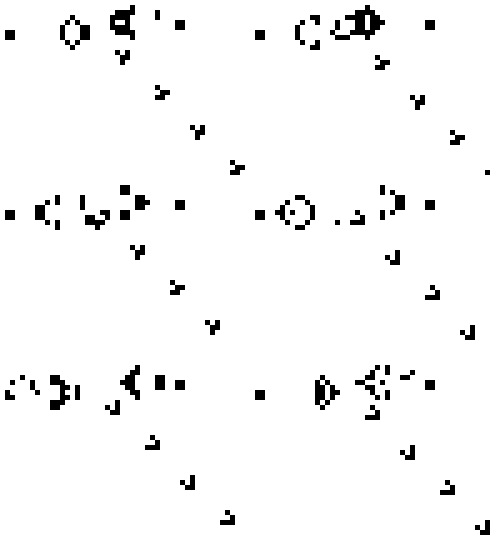


The initial pattern constitutes the seed of the system. The first generation is created by applying the above rules simultaneously to every cell in the seed—births and deaths occur simultaneously, and the discrete moment at which this happens is sometimes called a tick (in other words, each generation is a pure function of the preceding one). The rules continue to be applied repeatedly to create further generations.

The game is located at the following address: http://www.bitstorm.org/gameoflife/

Of the examples studied during the course, the bitmap example (Corcuff, 2008) with randomized pixel generation is located at the following address: http://www.random.org/bitmaps/

The exact same (a figure of speech) 10x10 pixel squares can be created to illustrate the beforementioned example. Squares up to 300x300 pixel with 4x zoom can be achieved with this tool.

Random.org hosts quite a few randomization centric solutions. Out of these the name Samuel Beckett caught the eye (randomly generated short prose). This relates directly to generative literature. The website states that:

"In 1969, the Irish-born writer Samuel Beckett (1906-1989) published the piece of short prose Sans in French. One year later, in 1970, it was followed by a translation (by Beckett himself) into English titled Lessness."
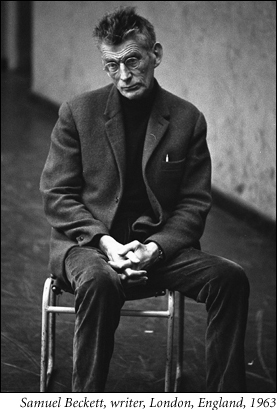

"An interesting characteristic of this work is its combination of dense aural and structural patterning and apparent randomess. Both versions consist of 24 paragraphs containing a total of 120 sentences. Each sentence occurs twice: once in the first half of the work and once in the last. Beckett later indicated to critics that the order in which the sentences in Lessness appear had been determined randomly by drawing little slips of paper out of a container." (Random.org, 2011).

The Random.org site allows you to create your own version of "Lessness". Although access to the site is free, it's still restricted due to copyright considerations. A password can be obtained by sending an e-mail.

Generative art has been discussed in great legths, but so far, generative literature has not been defined in this blog. Thus:

Generative literature, defined as the production of continuously changing literary texts by means of a specific dictionary, some set of rules and the use of algorithms, is a very specific form of digital literature which is completely changing most of the concepts of classical literature. (Balpe, 2005).

An overview of generative art and literature examples can be found on the following addresses:

http://www.random.org/
http://blog.hvidtfeldts.net/index.php/generative-art-links/
http://generatorblog.blogspot.com/


References

Wikipedia. (2011). Conway's Game of Life. Available: http://en.wikipedia.org/wiki/Conway's_Game_of_Life. Last accessed 27.01.2011.

Random.org. (2011). Possible Lessnesses. Available: http://www.random.org/lessness/. Last accessed 27.01.2011.

Random.org. (2011). Random bitmap generator (BETA). Available: http://www.random.org/bitmaps/. Last accessed 27.01.2011.

Balpe, J-P. (2005). Principles and Processes of Generative Literature. Available: http://www.brown.edu/Research/dichtung-digital/2005/1/Balpe/index.htm. Last accessed 27.01.2011.


05 December, 2010

Critical review - Chance and Generativity by Marie Pascale Corcuff

Introduction

Marie-Pascale Corcuff states that we, human beings, don't generally like to rely on chance. We like to control our life and thus, the use of randomness, seems to be an abdication of our power of decision.

The paper at hand is about the use of chance in generative processes. The author summarizes the key argument by stating that diversity may be obtained, without loosing identity.

Corcuff proves through a series of experiments that diversity in generative art processes can be obtained without loosing idetity. The meaning behind text can be somewhat hard to grasp at first sight. For example, the reader is expected to have previous knowledge about IFS (Iterated Function Systems). In mathematics IFS are a method of constructing fractals. Symbolically speaking:

\{f_i:X\to X|i=1,2,\dots,N\},\ N\in\mathbb{N}

The strengths and weaknesses of this paper relate to the same topic: experiments/examples. The author anticipates an audience familiar with mathematics. While the examples are sufficient (and it's always nice to have something explained to the reader in black and white), they may not be understood by all.

The purpose of this paper is to discuss and illustrate the different meanings of chance relatively to probability, combinations, imprevisibility, coincidence, chaos, disorder, control, intentionality - e.g. explain the concept of generative art.

Structure wise the paper is fairly simple. Chance is discussed in relation to unpredictability, insignificance and diversity. Examples of formal research are presented as well.

Chance and unpredictability refer to a set of rules required to generate unique results (generative art). A saying by Philip Galanter is chosen to illustrate this concept: "Generative art refers to any art practice where the artist creates a process, such as a set of natural language rules, a computer program, a machine or other procedural invention, which is then set into motion with some degree of autonomy contributing to or resulting in a complexed work of art."

Conway's game of life (http://en.wikipedia.org/wiki/Conway's_Game_of_Life) is a good example of this connection. Also, we can sow the seeds, but it's hard to predict how the garden will look like (Corcuff uses the garden metaphor as well).

Chance and insignificance refer to different methods of obtaining randomness for the sake of generative art. It's the insignificance of the result which is the proof of the randomness of the data. Chance and diversity argue that by defining a process, randomness may be useful to provide diversity. Children are not more complex than their parents, but they are different.

Summary

The key points of Corcuff's paper state that:
  • Diversity may be obtained, without loosing identity.
  • Chance refers to a set of rules defined to generate randomness.
The paper lacks a concrete summary of the findings. There is a conclusion, but it's very brief (probably due to the event-dictated format).

Generative art

A quote (used earlier in this review and also by mrs. Corcuff) by Philip Galanter best describes the essence of generative art:

"Generative art refers to any art practice where the artist creates a process, such as a set of natural language rules, a computer program, a machine or other procedural invention, which is then set into motion with some degree of autonomy contributing to or resulting in a complexed work of art."

Generative art is not solely computer based. Corcuff uses a garden metaphor to explain how chance works in relation to generative. Regarding historical context, Corcuff lists a book by Jaques Monod titled "Chance and necessity."

Critique

The paper lacked a summary of findings. There were a lot of examples (which is always nice when a difficult subject needs to be explained), but the conclusion was very brief. Also, the terms unpredictability, randmoness, diversity, insignificance were explained (through examples), but not defined. Thus, it was hard to distinguish what they meant and how they relate to each other.

Conclusions

Corcuff's opinion was that use of chance in artistic generative processes can produce diversity without sacrificing identity. This paper is very good in terms of explaining how generative processes work (e.g. the 10x10 pictures, the Library of Babel etc). Although in requires a technical background in some parts, it's still useful for those who are new to generative art and need an introduction.

References

Corcuff, Marie-Pascale. 2008. Chance and Generativity. In GA2008, 11th Generative Art Conference, 189-199. Retrieved 21.12.2010 from http://www.generativeart.com/on/cic/papersGA2008/16.pdf

Wikipedia. (2011). Conway's Game of Life. Available: http://en.wikipedia.org/wiki/Conway's_Game_of_Life. Last accessed 21.12.2011.

Wikipedia. (2011). Iterated function system. Available: http://en.wikipedia.org/wiki/Iterated_function_system. Last accessed 21.12.2011.

14 November, 2010

A Companion to Digital Humanities: Multimedia. A Critical Review

Introduction

"A Companion to Digital Humanities" offers a collection of articles (37 alltogether) about the field of humanities computing. One of those articles is written by Geoffrey Rockwell and Andrew Mactavish. It is titled "Multimedia" (A Companion to Digital Humanities, ed. Susan Schreibman, Ray Siemens, John Unsworth. Oxford: Blackwell, 2004. http://www.digitalhumanities.org/companion)

The following is a critical review regarding this article. A short introduction about the topic is provided by the authors:

"How do we think through the new types of media created for the computer? Many names have emerged to describe computer-based forms, such as digital media, new media, hypermedia, or multimedia. In this chapter we will start with multimedia, one possible name that captures one of the features of the emerging genre."

The article was produced in 2004, so we have to take into account that the contents may not be as conteporary as one might expect.


What is Multimedia?

Rockwell and Mactavish introduce two definitons of multimedia and propose a third one that "combines many of the features in the others with a focus on multimedia as a genre of communicative work:"

A multimedia work is a computer-based rhetorical artifact in which multiple media are integrated into an interactive whole.

The authors go on and use parts of the definition to analyze multimedia. These parts include:

- "computer based"
- "rhetorical artifact"
- "multiple media"
- "integrated whole"
- "interactive"

While being short and concrete, this definition needs to be updated and some critique is required. Today multimedia can be created and accessed by a number of devices including cellphones, MP3 players and tablets. The list is by no means final. Cellphones have 1 GHz processors and the word "computer" may refer to a variety of devices.

Also, "rhetorical artifact" is a very vague term to describe content. If we look at Facebook, it's certainly a multimedia gateway (sending, receiving and creating videos, photos and text using the Facebook platform). On the other hand, it's a collection of data and it has administrative capabilities regarding content.

The authors have excluded randomness from the definition of multimedia by stating that there's a creator and the intent for the work to be experienced as an artistic whole. Different platforms and technologies allow random content creation (user generated content) that is forwarded to the recipient in a feed form. The feed itself can combine various types of media and provide access to various types of media. By recording chat-roulette (www.chatroulette.com) sessions one may compile a totally random multimedia work. Examples can be found on the Youtube.


Types of Multimedia

The authors argue that "the challenge of multimedia to the humanities is thinking through the variety of multimedia artifacts and asking about the clusters of works that can be aggregated into types."

They propose the following list:

- Web hypermedia
- Computer games
- Digital art
- Multimedia encyclopedia

Such categorization is always dangerous. It's leaves little room for change and things do tend to change. Especially in the field of multimedia and everything interactive. Web hypermedia is a good primary category, but it's too general, today all the other categories might as well be parts of the first one. Rigid categorization is out of date, because information (regarding it's objective) is consumed and manipulated online.


History

The history section of this article requires little critique, it's accurate, but not very comprehensive. It's understood and probably related to length restrictions and the primary focus of the article.

Numbers and text, images, desktop publishing, authoring environments, sound, digital video and virtual space are discussed. Various categorizations may exist.


Main Academic Issues

Rockwell and Mactavish introduce few of the academic issues related to multimedia:

- Best practices in multimedia production.
- Game criticism and interactivity.
- Theories and histories of multimedia.

The list is by no means comprehensive. Many other issues exist, but Rockwell and Mactavish do not argue otherwise. All of the mentioned issues are still being studied today, but some new and interesting issues have emerged. For example, the use of multimedia in the field of education and learning.


Conclusion

The authors seem to think of multimedia as something static. They propose very rigid and concrete categories and forget to mention the dynamic essence of multimedia. It's an overview on the topic of multimedia, not a comprehensive analysis. The authors understand that and suggest links and materials for further reading. Even so, the article should have taken into account the possibility of change.